Nageshwarnath Temple, Ayodhya: Built by Kusha, Son of Rama
A complete guide to the Nageshwarnath Shiva temple at Ayodhya: said to have been established by Kusha, the son of Lord Rama, the temple that helped King Vikramaditya rediscover the lost city of Ayodhya, and the celebration of Mahashivratri here.
Nageshwarnath Temple is one of Ayodhya’s oldest active shrines: a Shiva temple of profound importance in the city’s mythology, said to have been established by Kusha, the elder son of Lord Rama, after the great king’s reign. The temple sits close to the Sarayu and is the traditional starting point of the Antargrahi parikrama of Ayodhya.
The legend of Kusha and the Nag-Kanya
According to the Skanda Purana and continuous local tradition, the temple’s origin story is one of Ayodhya’s most beloved:
While bathing in the Sarayu, the prince Kusha lost his armlet (angad) in the river. A Nag-Kanya: a serpent maiden: found and recovered it. She fell in love with the young prince. Being a devotee of Shiva herself, she would not act on her affections; she asked Kusha instead to build a Shiva temple at this spot in the city. Kusha, moved by her devotion, did so: and that temple is the original Nageshwarnath.
Vikramaditya’s rediscovery
The temple’s mythological importance is matched by a striking historical claim. According to chronicles preserved in the gazetteer tradition, the temple was the only structure to have survived from the time of the great King Vikramaditya (1st century BCE, by tradition), when the rest of Ayodhya had fallen into ruins and was covered by dense forest.
When Vikramaditya: by tradition: set out to rediscover the lost capital of his ancestors’ faith, it was the still-standing Nageshwarnath that allowed him to identify the precise location of Ayodhya and the sites of its other shrines. The city was then rebuilt around it.
Mahashivratri
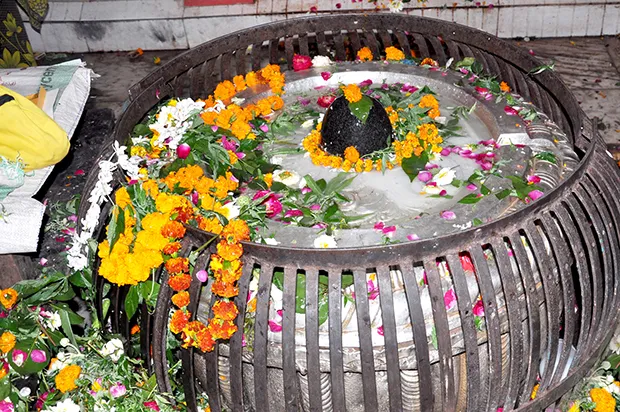
Mahashivratri: the great night of Shiva, celebrated in Phalguna (February–March): is the festival of festivals at Nageshwarnath. Lakhs of devotees arrive to perform abhishekam through the night, with continuous chanting of Om Namah Shivaya and the offering of bilva leaves on the Shivalinga.
Visiting
- Timings: Approximately 4:30 am to 10:00 pm; longer on Mondays (the day of Shiva) and during Shravan month (July–August).
- Mondays in Shravan are especially crowded for the Sawan Somvar abhishekam.
- The temple is on the Antargrahi parikrama route: pilgrims doing the short circumambulation begin and end nearby.
- Photography: permitted in the outer courtyard.
Nearby
Sources & References
- Skanda Purana, Ayodhya Mahatmya
- District Gazetteer of Faizabad
- Local temple inscription and oral tradition