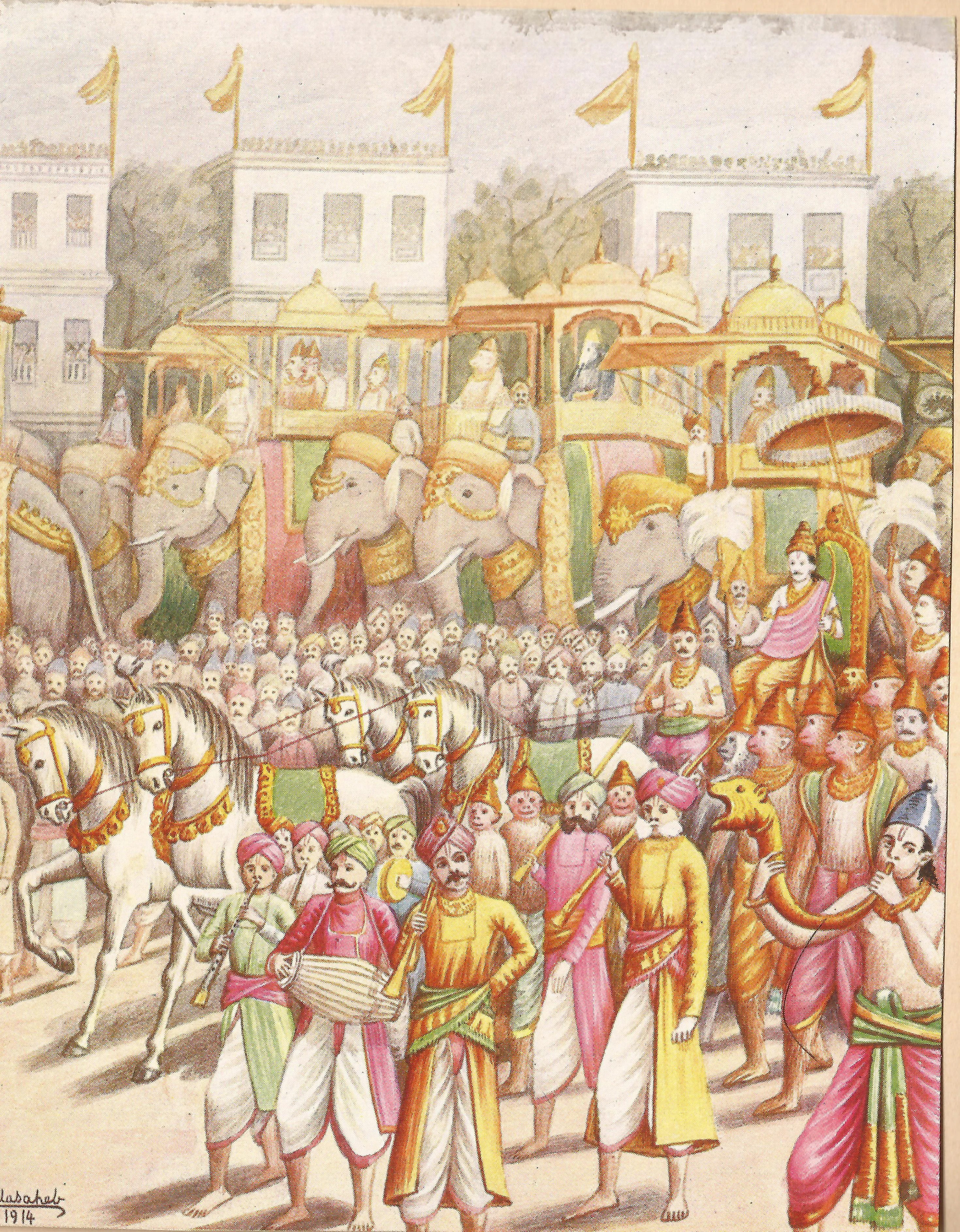
Legends of Ayodhya: The Surya Dynasty and Lord Rama
The mythological foundations of Ayodhya: its founding by Manu, the lineage of King Ikshvaku, the great kings Harishchandra and Raghu, and the birth of Lord Rama in the Surya (solar) dynasty.
Ayodhya is intimately bound to Lord Rama, the seventh avatar of Lord Vishnu. According to the Ramayana, the ancient city was founded by Manu, the law-giver of the Hindu tradition and the progenitor of the human race, at the dawn of this yuga. For unbroken centuries it served as the capital of the Surya Vansha (solar dynasty), of whom Rama was the most celebrated king.
In the deepest antiquity the surrounding region was known as Kosala-desa, and Ayodhya was its imperial seat.
How the city took its name
Ayodhya is named after King Ayudh, its founder, an ancestor in the line that culminated in Rama. The same Raghuvanshi dynasty produced the great Raja Harishchandra, celebrated across Indian literature for his unwavering commitment to truth, whose story has been retold in countless Puranas and modern dramas.
The Ikshvaku line
The illustrious Ikshvaku, eldest son of Vaivasvata Manu, was the founder of the solar clan and established his throne at Ayodhya. The earth itself, according to the Vishnu Purana, derives its name Prithivi from Prithu, the sixth king of this line.
A few generations on came Mandhatri, and after him, in the thirty-first generation, came Harishchandra.
In the same line later appeared:
- Raja Sagara, who performed the Asvamedha (horse-sacrifice) yajna,
- Bhagiratha, his great-grandson, who through severe penance brought down Ganga from the heavens to redeem his ancestors’ souls,
- Raghu, whose fame was so great that the entire dynasty came to be called Raghuvamsha: the line of Raghu,
- Raja Dasharatha, the illustrious father of Rama, in whose reign the glory of the Kosala dynasty reached its highest point.
Rama and the poets
It was the sage Valmiki who composed the original Ramayana (Valmiki Ramayana), recounting the life of Sriram. Later poets continued the tradition: Kamban wrote his Tamil Iramavataram, and in the 16th century the saint Tulsidas composed the Ramcharitmanas in Awadhi: a text now revered across north India and one of the most beloved scriptures of Sanatana Dharma.
The opening chapters of the Ramayana describe Ayodhya in extraordinary detail: the magnificence of its walls, the wisdom of its monarchs, the prosperity, learning, and unwavering loyalty of its citizens. Several of the Tamil Alvars also sing the praise of Ayodhya in their bhakti poetry of the early medieval period.
Birthplace of many
Beyond Lord Rama, Ayodhya is also recorded as the birthplace of:
- King Bharata, the first Chakravarti emperor;
- Bahubali, Brahmi, and Sundari of the Jain tradition;
- King Dasharatha, father of Rama;
- Acharya Padaliptasurisvarji;
- King Harishchandra;
- Shri Rama Achalbhrata and the ninth Gandhara of Mahavira Swami.
A city made by the gods
The Atharvaveda describes Ayodhya as a city made by the gods, prosperous as heaven itself. The Skanda Purana and several other Puranas count Ayodhya among the seven holiest cities of India: the sapta-puris whose mere remembrance grants liberation:
“Ayodhya, Mathura, Maya, Kashi, Kanchi, Avantika, Puri Dvaravati chaiva: sapta etā mokṣadāyikāḥ.”
The seven cities that bestow moksha.
References
- Valmiki Ramayana, Bala Kanda
- Skanda Purana
- Atharvaveda, Hymn 10.2.31
- Tulsidas, Ramcharitmanas