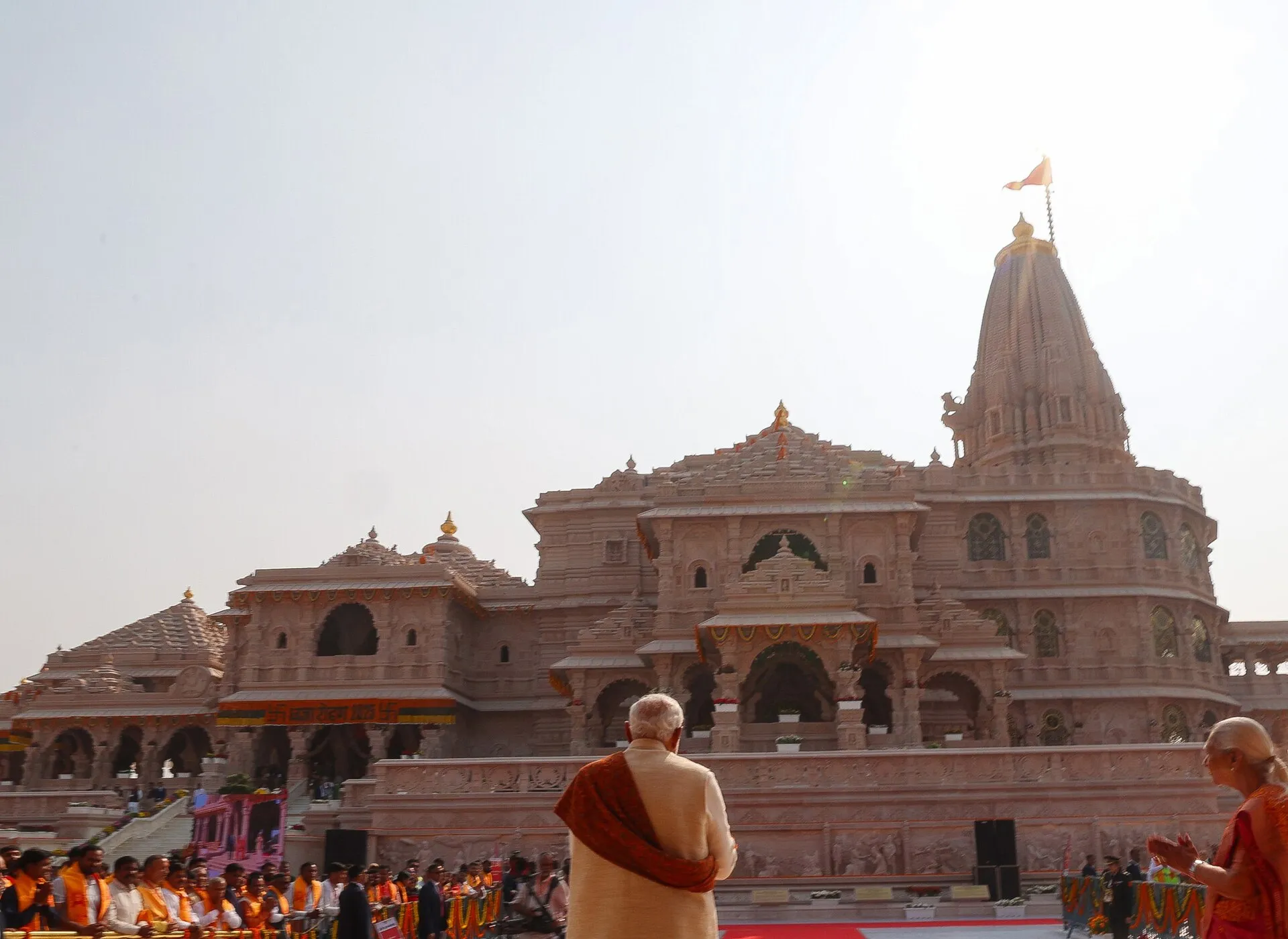
Ram Janmabhoomi Mandir: Architecture & Design
The architectural design of the Ram Janmabhoomi Mandir at Ayodhya: Nagara style, Sompura family architects, dimensions, the 392 carved pillars, the five mandapas, Bansi Paharpur sandstone, the Ram Lalla idol, and the seven sage mandapas of the parkota.
The Ram Janmabhoomi Mandir is built in the classical Nagara style of north Indian temple architecture, designed by the Sompura family of Ahmedabad: hereditary temple architects whose lineage has been responsible for major temples across India for fifteen generations, including the Somnath Temple’s reconstruction.
The principal shrine
Key dimensions and features of the main temple:
- Length: 380 feet (east–west)
- Width: 250 feet
- Height: 161 feet (including the main shikhara)
- Three storeys, each 20 feet high
- 392 pillars, intricately carved with deities, devotees, and floral motifs
- 44 doors
- Five mandapas (pavilions), each serving a specific ritual function:
- Nritya Mandap: for sacred dance
- Rang Mandap: for performances
- Sabha Mandap: the assembly hall
- Prarthana Mandap: for prayer
- Kirtan Mandap: for devotional singing
Materials and construction technique
The temple is constructed entirely from Bansi Paharpur sandstone, sourced from Bharatpur district in Rajasthan: chosen for its long-lasting pinkish hue and traditional use in Hindu temple architecture for over a millennium. Crucially, no iron is used anywhere in the structural design of the temple. The entire structure is held together by interlocking stonework, in keeping with the centuries-old Nagara tradition. This choice is both architecturally authentic and practically sound: the absence of iron eliminates the corrosion that has weakened many medieval temples over centuries.
The foundations rest on a 14-metre-thick raft of engineered concrete, with a 21-foot-tall granite plinth above it: a modern engineering response to the soil conditions at Ayodhya, designed for a thousand-year lifespan.
The Ram Lalla Virajman idol
The principal idol in the garbhagriha (sanctum) is Ram Lalla Virajman: Lord Rama in his five-year-old child form (bal swaroop): sculpted by Arun Yogiraj of Mysore from a single block of black Krishna shila stone. The idol stands 51 inches tall, depicted holding a small bow and arrow, with the symbols of the Surya Vansha (the solar dynasty) carved into the surrounding aureole.
Two earlier candidate idols, by sculptors Ganesh Bhatt and Satyanarayan Pandey, are also installed at other shrines within the complex. The Ram Lalla idol from the original demolished structure (the 1949 Virajman idol) has been reverently retained and is also worshipped within the complex.
The temple complex (parkota)
The wider complex (parkota) is enclosed by a rectangular wall 732 metres in perimeter, with corner shrines dedicated to:
- Surya Dev (the Sun God, ancestor of Rama’s solar dynasty)
- Bhagwati (the Mother Goddess)
- Ganesh
- Shiva
- Hanuman
- Annapurna (the goddess of nourishment)
These six rampart shrines were unified for public worship on 5 June 2025.
The seven sage mandapas
Within the broader complex, seven mandapas honour the rishis and devotees most closely associated with Lord Rama’s earthly journey:
- Maharishi Valmiki: composer of the Ramayana
- Maharishi Vasishtha: preceptor of the Ikshvaku dynasty
- Maharishi Vishwamitra: Rama’s first teacher of advanced weaponry
- Maharishi Agastya: sage of the southern dakshina-pathra
- Nishad Raj: the boatman king who ferried Rama across the Sarayu
- Mata Shabari: the devotee whose hospitality Rama accepted in the forest
- Ahalya: restored to her form by Rama’s touch
These seven mandapas were completed alongside the main shrine and consecrated together on 25 November 2025, when the Prime Minister hoisted the ceremonial saffron flag atop the main shikhara, formally marking the completion of the entire temple complex. Total project cost: approximately ₹1,900 crore.
Gold yantra installation (March 2026)
On 19 March 2026, during the Abhijit muhurta (the most auspicious moment of the day), a 150 kg gold-plated copper yantra measuring 3 feet by 3 feet was installed on the second floor of the main sanctum. The ceremony was conducted in the presence of President Droupadi Murmu. A yantra is a sacred geometric diagram that serves as a focal point for concentrated divine energy; its installation on the upper floor of the temple is a milestone in the ritual completion of the garbhagriha.
Sources & References
- Sompura family architects (Chandrakant Sompura and associates): design publications
- Shri Ram Janmabhoomi Teerth Kshetra Trust: official architectural specifications
- Press Information Bureau, Government of India: January 2024 release